 EN
 NL
 FR
 IT
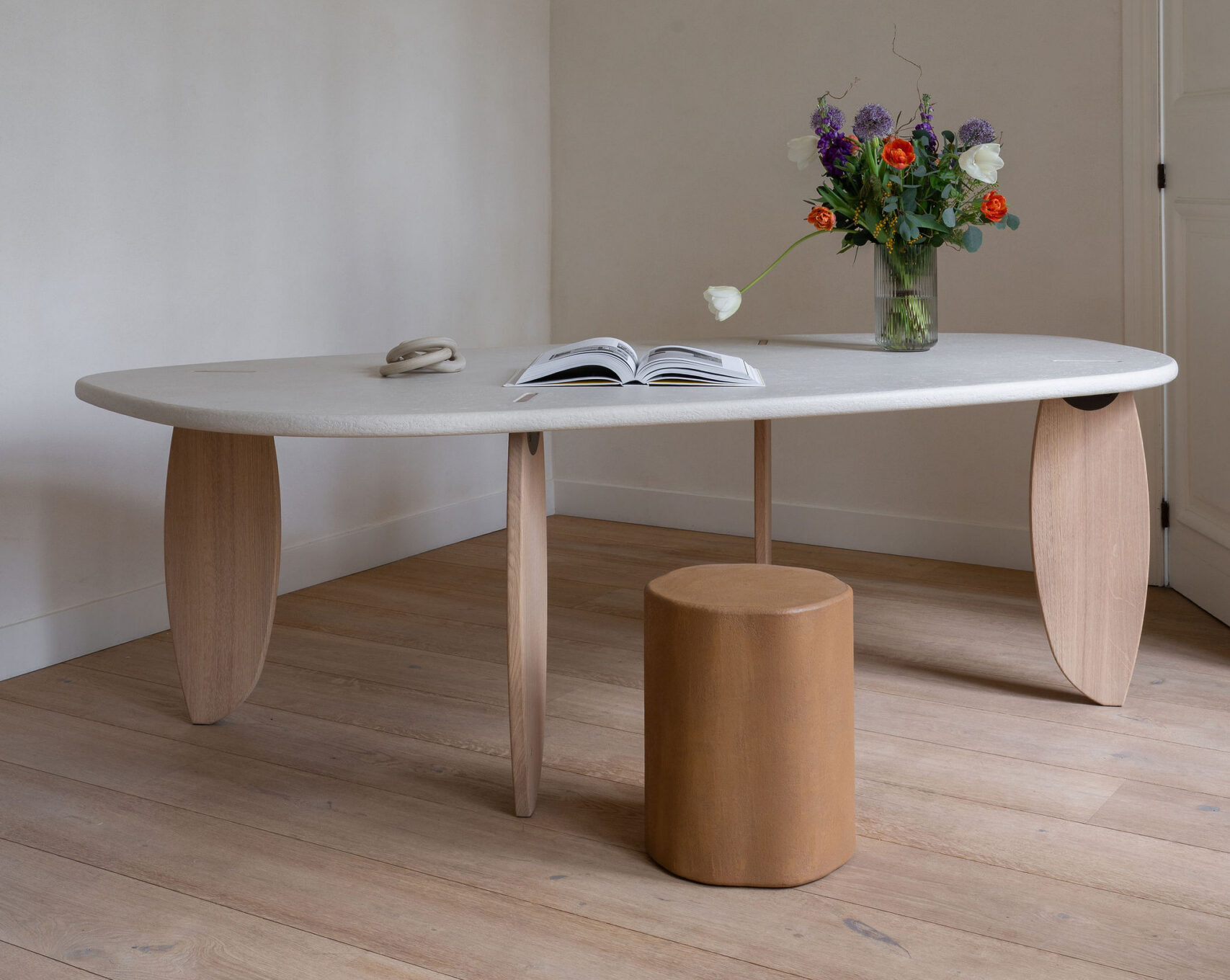
A dining table is more than a place to eat. It’s where conversations happen, where people gather, and often, where some of the best moments at home take place.
So choosing the right one deserves a little thought.
Shape, size and design all matter. But there’s another decision that can completely change how a dining table looks, feels and fits into your everyday life: the best material for your dining table.
Mortex, natural stone and solid wood are three distinctive choices for a designer dining table. Each has its own character, advantages and practical considerations.
Perhaps you’re drawn to the seamless, sculptural appearance of a Mortex table. Maybe you love the natural veining of marble or the warmth of solid oak. Or perhaps you’re still figuring out what would work best in your interior.
Let’s compare them. Not to declare one material the winner, but to help you find the one that feels right for your home.
1. Mortex, natural stone and solid wood: what’s the difference?
Before comparing the materials, it’s worth understanding what makes each one unique.
Mortex: a seamless, mineral finish
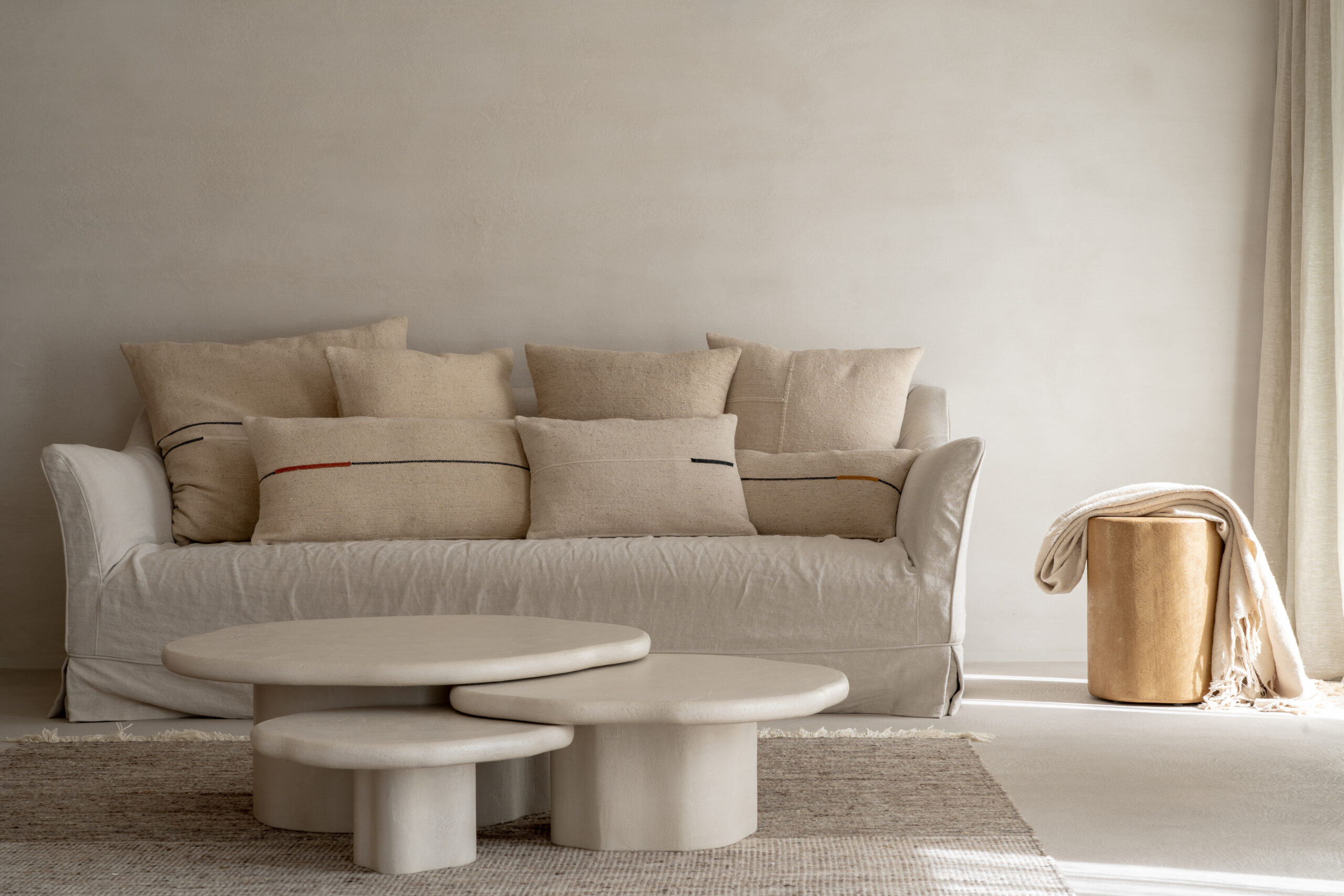
Mortex is a mineral coating system that creates a refined, stone-like appearance. It belongs to the broader category of mineral finishes often associated with microcement, although Mortex is a specific product with its own composition and application process.
Unlike a solid stone tabletop, a Mortex dining table typically consists of a stable underlying structure finished with several thin layers of mineral coating.
These layers are applied by hand, creating a continuous surface with subtle variations in texture and colour.
The result?
A contemporary, tactile appearance that combines the raw character of concrete with a softer, more refined aesthetic.
One of the most interesting characteristics of Mortex is its versatility. Because the finish is applied to a prepared structure, it allows designers to explore shapes and proportions that would be difficult or impractical to achieve with solid stone.
At Atelier Nilsen, Mortex is an important part of our design language. Its mineral texture complements the organic shapes and sculptural forms that characterise many of our furniture pieces.
Best suited for: contemporary interiors, organic furniture designs, sculptural dining tables and people who appreciate subtle texture.
Natural stone: character shaped by nature
Marble, travertine, limestone and granite have been used in architecture and furniture for centuries.
And for good reason.
Every piece of natural stone carries its own history, expressed through veining, colour variations, mineral patterns and texture.
No two slabs are exactly alike.
A marble dining table can feel elegant and expressive, while travertine introduces softer, earthy tones. Granite offers a different character again, often with a more granular appearance.
However, not all natural stones behave in the same way.
Marble and limestone, for example, are sensitive to acidic substances, which can cause etching. Granite is generally more resistant to scratching and staining, although its performance depends on the specific stone and finish.
Natural stone is also relatively heavy, which can influence the design of the base, transportation and installation.
Best suited for: interiors where natural patterns, distinctive veining and the authenticity of solid stone are central to the design.
Solid wood: natural warmth and timeless appeal
There’s something about wood that immediately makes an interior feel welcoming.
Solid oak, walnut and other hardwoods introduce warmth, depth and a connection to nature.
Their grain patterns, knots and colour variations give every tabletop an individual character.
Wood is also a living material in the sense that it responds to changes in humidity and temperature. It can expand and contract over time, which needs to be considered during construction and everyday use.
One of its greatest advantages is that many solid wood surfaces can be refinished, depending on their treatment and construction.
A scratch or mark doesn’t necessarily mean the end of the table’s beautiful appearance.
Best suited for: warm, natural interiors, timeless furniture designs and people who appreciate materials that develop character over time.
2. Which material looks best in your interior?
This is probably the first question most people ask.
And the answer depends less on the material itself than on the atmosphere you want to create.
Mortex: understated, sculptural and contemporary
Mortex has a distinctive visual quality.
Its seamless surface creates a sense of continuity, allowing the shape of the furniture to become particularly prominent.
This makes it an interesting choice for sculptural dining tables.
Instead of focusing on dramatic veining or visible wood grain, the eye is drawn towards the proportions, curves and architectural character of the design.
A Mortex table can be a statement piece without feeling visually overwhelming.
Its subtle mineral variations introduce texture while maintaining a calm, cohesive appearance.
Consider Mortex if you want your dining table’s shape to be the main attraction.
Natural stone: expressive and distinctive
Natural stone often makes a statement through the material itself.
A beautifully veined marble tabletop can become the centrepiece of an entire dining room.
Travertine creates a different atmosphere, with its natural texture and warm, earthy character.
Because the material already contains so much visual interest, natural stone works particularly well when combined with restrained furniture and architectural details.
Consider natural stone if you want the material’s natural patterns to define the table.
Solid wood: warm and inviting
Wood brings a different kind of presence.
Rather than feeling monumental or architectural, it often creates an immediate sense of warmth.
Light oak can complement minimalist interiors, while darker walnut introduces richness and contrast.
Wood also works beautifully alongside other natural materials, such as linen, leather, stone and mineral finishes.
Consider solid wood if warmth, texture and a natural atmosphere are your priorities.
A quick comparison
| Characteristic | Mortex / microcement-style finish | Natural stone | Solid wood |
|---|---|---|---|
| Appearance | Seamless, mineral, understated | Natural veining and patterns | Visible grain and warm texture |
| Visual character | Sculptural and contemporary | Elegant and expressive | Natural and inviting |
| Surface variation | Subtle, created during application | Unique to each slab | Unique grain and colour |
| Shape possibilities | Highly versatile | Influenced by stone properties and fabrication | Versatile, with construction considerations |
| Typical visual weight | Can appear solid or lightweight | Often substantial | Depends on design and thickness |
| Overall atmosphere | Calm, architectural | Distinctive, luxurious | Warm, timeless |
Of course, the final appearance also depends on the furniture’s design, finish and proportions.
A solid wood table can be highly sculptural, just as a Mortex table can feel warm and inviting.
The material is only part of the story.
3. Which dining table material is the most durable?
A dining table needs to do more than look beautiful.
It also needs to withstand everyday life.
Coffee cups. Dinner parties. Children doing homework. The occasional spilled glass of wine.
So how do these materials compare?
Is Mortex durable enough for everyday dining?
Yes, when professionally applied and properly protected, Mortex can be suitable for everyday dining tables.
The mineral coating creates a hard-wearing surface, while protective finishing layers help resist moisture, dirt and normal daily use.
However, Mortex is not indestructible.
Sharp objects can cause scratches, aggressive cleaning products may damage the protective finish, and prolonged exposure to staining substances should be avoided.
The quality of the underlying structure is also essential.
Because Mortex is applied as a thin coating, an unstable substrate can increase the risk of cracking.
At Atelier Nilsen, careful preparation, handcrafted application and protective finishing are important parts of the production process.
The takeaway: Mortex is a practical choice for everyday furniture, provided it is correctly manufactured and treated with reasonable care.
How durable is a natural stone dining table?
Natural stone is often associated with strength and permanence.
But hardness doesn’t automatically mean stain resistance.
Different stones have very different properties.
Marble is relatively sensitive to acids such as lemon juice, vinegar and wine. These can cause etching, leaving dull marks on the surface.
Travertine is porous and may require sealing and appropriate maintenance.
Granite is generally harder and more resistant to scratching, although it can still be damaged or stained under certain conditions.
Stone can also chip along edges or corners if struck with sufficient force.
The specific type of stone, its porosity, surface treatment and finish all influence how it performs.
The takeaway: Natural stone can last for generations, but choosing the right stone and understanding its maintenance requirements is essential.
How durable is a solid wood dining table?
A well-made solid wood table can last for decades.
However, wood is generally more susceptible to dents and scratches than many stone surfaces.
Its resistance depends on the wood species, surface treatment and how the table is used.
The good news?
Many solid wood tables can be sanded and refinished, allowing signs of wear to be reduced or repaired.
Wood also changes naturally over time.
Exposure to sunlight can influence its colour, while changes in humidity can cause expansion or contraction.
These characteristics aren’t necessarily disadvantages, but they do require consideration.
The takeaway: Solid wood is a long-lasting material that can often be restored, making it an attractive option for people who appreciate furniture that ages naturally.
4. Which dining table is easiest to maintain?
Let’s be practical.
Most people don’t want to spend more time cleaning their dining table than actually using it.
Fortunately, all three materials can be manageable with the right care.
Maintaining a Mortex dining table
A professionally finished Mortex table is relatively easy to maintain.
For everyday cleaning, a soft, slightly damp cloth is usually sufficient.
If needed, use a mild, pH-neutral cleaning product.
Avoid abrasive sponges, aggressive chemicals and highly acidic cleaners.
Spills should be wiped away promptly, particularly substances such as coffee, red wine, lemon juice and vinegar.
Use coasters, placemats and trivets to protect the surface from scratches, stains and excessive heat.
Maintenance level: Low to moderate, depending on the finish and how the table is used.
Maintaining a natural stone dining table
Natural stone requires material-specific care.
For marble and limestone, acidic cleaning products should be avoided because they can damage the surface.
Some stones require periodic sealing to help reduce moisture absorption and staining.
Regular cleaning with a suitable stone cleaner and prompt attention to spills are recommended.
Hot objects and heavy impacts should also be treated with care.
Maintenance level: Moderate, although this varies significantly between stone types.
Maintaining a solid wood dining table
Solid wood is generally straightforward to clean.
Use a soft cloth and a cleaning product suitable for the table’s finish.
Avoid leaving water on the surface and protect it from excessive heat.
Depending on the treatment, the table may occasionally require oiling, waxing or other maintenance.
It’s also important to avoid extreme fluctuations in temperature and humidity.
Maintenance level: Low to moderate, depending on whether the wood is oiled, lacquered or otherwise treated.
Which material requires the least maintenance?
There is no universal winner.
A properly protected Mortex table may be easier to maintain than an untreated marble table.
A lacquered wooden table may require less regular treatment than an oiled one.
And a dense, appropriately finished granite tabletop may perform differently from porous limestone.
The important question isn’t simply which material you choose.
It’s how that material has been finished and how you intend to use it.
5. Which material offers the most design freedom?
Here’s where things become particularly interesting.
Especially if you’re looking for a dining table that goes beyond conventional shapes.
Mortex: freedom to explore sculptural forms
Because Mortex is applied to a prepared structure rather than carved from a solid block, it offers considerable design flexibility.
Curved edges, organic tabletops and sculptural bases can be created without relying on the dimensions or weight of a natural stone slab.
This makes mineral finishes particularly interesting for contemporary furniture design.
The tabletop and base can also be conceived as a single visual composition, with the same finish continuing across different elements.
The result can feel almost architectural.
At Atelier Nilsen, this freedom plays an important role in the development of our furniture.
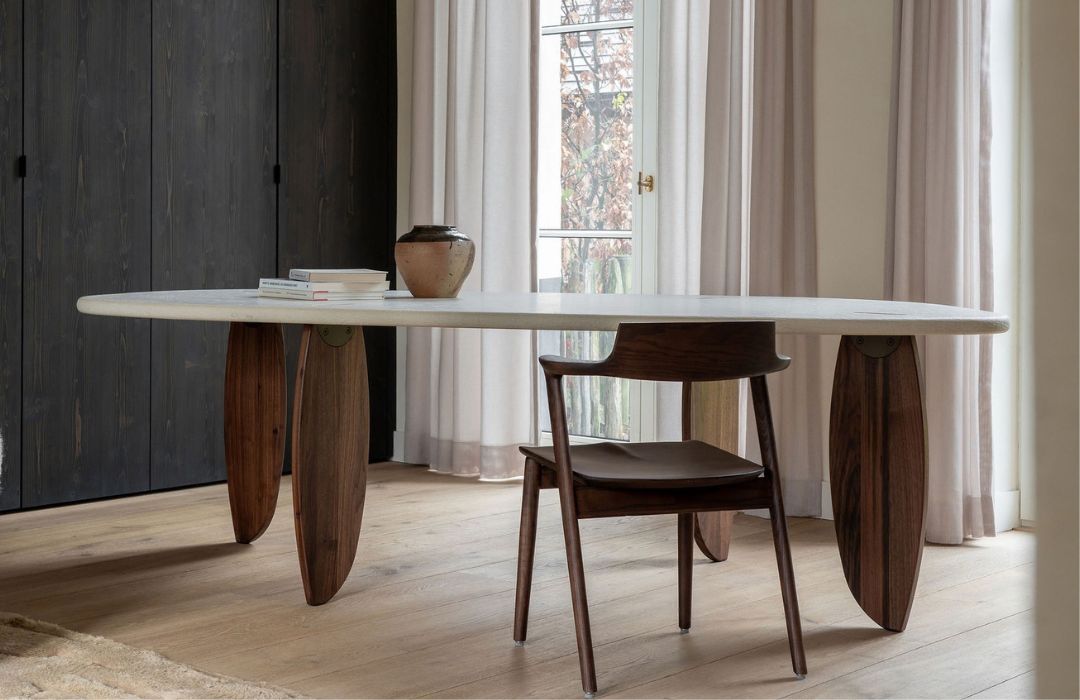
In the FLINT collection, for example, the relationship between the tabletop and its supporting elements forms an essential part of the design language.
The table becomes more than a surface supported by legs.
It becomes one coherent object.
Natural stone: beautiful, but with practical limitations
Stone can certainly be shaped into impressive furniture.
However, its weight, thickness, brittleness and fabrication requirements influence what is possible.
Complex curves and sculptural bases may require specialised machinery, structural reinforcement or multiple pieces of stone.
Large slabs can also introduce limitations in terms of dimensions and transportation.
These challenges can be overcome, but they influence design possibilities and production costs.
Solid wood: versatile and expressive
Wood offers considerable creative freedom.
It can be shaped, carved, joined and combined with other materials.
Curved edges, organic forms and sculptural bases are all possible, depending on the construction technique.
However, the natural movement of solid wood needs to be considered.
Very large surfaces and complex forms require careful design to accommodate changes in humidity and temperature.
If sculptural freedom is your priority, Mortex and solid wood offer interesting possibilities, while natural stone introduces its own distinctive opportunities and constraints.
6. What about weight?
Weight is often overlooked when choosing a dining table.
Until the day it needs to be delivered.
Or moved.
Or installed on an upper floor.
Mortex vs solid stone: is Mortex lighter?
A Mortex table is often considerably lighter than a similarly sized table made from solid concrete or thick natural stone.
That’s because Mortex is a thin mineral coating applied over an underlying structure.
However, the total weight depends on the construction, dimensions and materials used.
A large Mortex dining table with a substantial base can still be very heavy.
Natural stone
Natural stone is dense and often requires careful planning during transportation and installation.
Large stone tabletops may need several people or specialised equipment to move safely.
Floor loading, access routes and installation conditions should be considered for particularly heavy pieces.
Solid wood
Solid wood is generally lighter than a comparable volume of natural stone, although weight varies considerably by species and construction.
A large, thick oak tabletop can still be substantial.
Our advice: If your dining table needs to be carried upstairs, through narrow doorways or into a difficult-to-access space, discuss dimensions, weight and installation requirements before ordering.
7. Which material is the most sustainable?
Sustainability is about more than choosing a material that looks natural.
It also involves production methods, sourcing, transportation, durability, maintenance and what happens to the furniture at the end of its useful life.
Mortex and mineral finishes
Mortex uses a relatively thin layer of mineral material over a supporting structure.
However, the environmental impact depends on the composition of the coating, the substrate, protective products, manufacturing process and expected lifespan.
It would be misleading to claim that all microcement furniture is automatically more sustainable than solid stone or wood.
What can make a difference is creating furniture that is designed to last, manufactured responsibly and maintained over many years.
Natural stone
Natural stone is durable and can remain in use for generations.
However, quarrying, processing and transporting heavy stone slabs can have a significant environmental impact.
The origin of the stone, processing methods and transportation distances all matter.
Solid wood
Wood is a renewable material when sourced from responsibly managed forests.
It also stores carbon during its useful life.
However, not all wood has the same environmental profile.
Species, origin, forestry practices, processing, adhesives, finishes and transportation influence the overall impact.
Longevity matters
A beautifully designed dining table that remains in use for decades can be a better long-term choice than furniture that is frequently replaced.
At Atelier Nilsen, we believe in creating furniture with lasting aesthetic value.
Our pieces are handcrafted to order in our Belgian atelier, combining carefully selected materials with a considered approach to design.
Rather than following short-lived trends, we focus on forms and finishes intended to remain relevant over time.
Ultimately, the most sustainable dining table is one that is responsibly made, appropriately maintained and kept in use for as long as possible.
8. Which material is the most expensive?
Price is another important consideration.
But comparing dining table materials purely on price per square metre rarely tells the full story.
A dining table’s final price depends on:
- the material and its quality;
- dimensions;
- design complexity;
- construction;
- craftsmanship;
- surface treatment;
- customisation;
- transportation and installation.
Mortex dining tables
The cost of a Mortex table is influenced heavily by the handcrafted application process.
Multiple layers need to be applied, refined and protected, often requiring considerable time and expertise.
A sculptural Mortex dining table may also involve complex underlying construction.
Natural stone dining tables
Natural stone prices vary enormously.
Some stones are relatively accessible, while rare marble varieties or large premium slabs can be exceptionally expensive.
Cutting, shaping, finishing and transportation add to the final cost.
Solid wood dining tables
Wood prices depend on the species, quality, dimensions and construction.
A solid oak table can differ significantly in price from a bespoke walnut dining table with a complex sculptural base.
So, which offers the best value?
Rather than comparing materials in isolation, consider what you’re paying for.
A carefully designed and handcrafted dining table includes much more than raw material.
You’re also investing in design, craftsmanship, construction quality and the ability to enjoy the piece for years to come.
For a statement dining table, these qualities can be just as important as the material itself.
9. Mortex vs natural stone vs solid wood: comparison at a glance
Still undecided?
Here’s a practical overview.
| Consideration | Mortex / microcement-style finish | Natural stone | Solid wood |
|---|---|---|---|
| Appearance | Seamless, mineral, contemporary | Natural veining, distinctive patterns | Warm, visible grain |
| Uniqueness | Hand-applied surface variations | Each slab is naturally unique | Each piece has unique grain |
| Design flexibility | Excellent for organic and sculptural forms | Possible, with fabrication constraints | Versatile, with construction considerations |
| Scratch resistance | Good with proper protection, not scratch-proof | Depends on stone type | Depends on wood species and finish |
| Stain resistance | Depends on protective finish | Depends on stone and sealing | Depends on surface treatment |
| Heat resistance | Use trivets to protect the finish | Depends on stone and finish | Use trivets to prevent damage |
| Maintenance | Generally straightforward | Material-specific care | Depends on treatment |
| Weight | Depends on underlying structure | Often relatively heavy | Generally lighter than solid stone |
| Repairability | Specialist repair may be possible | Specialist repair may be possible | Often possible to refinish |
| Aesthetic character | Sculptural, understated | Expressive, natural | Warm, timeless |
| Ideal for | Contemporary statement furniture | Material-led interiors | Warm, natural interiors |
This comparison describes general characteristics. Actual performance depends on the specific product, construction, surface treatment and maintenance.
10. Which material should you choose for your dining table?
There’s no single material that works best for every interior.
The right choice depends on what matters most to you.
Choose Mortex if…
You appreciate contemporary design, organic shapes and seamless surfaces.
You want a dining table with a sculptural character, where the proportions and form are just as important as the material.
You enjoy subtle textures and prefer an understated mineral appearance over pronounced natural patterns.
A handcrafted Mortex dining table is particularly interesting when you’re looking for something architectural and distinctive.
Choose natural stone if…
You’re drawn to the natural beauty of marble, travertine, granite or limestone.
You want the material itself to become a defining feature of your dining area.
You appreciate unique veining and mineral patterns and are comfortable with the maintenance requirements of your chosen stone.
Choose solid wood if…
You want to introduce warmth and natural character into your interior.
You appreciate visible grain, tactile surfaces and furniture that can develop character over time.
You value the possibility of refinishing a surface and enjoy the timeless appeal of materials such as oak or walnut.
Or consider combining materials
Who says you have to choose only one?
Combining materials can create an interesting balance between warmth and architectural character.
A mineral finish paired with solid oak introduces contrast between the seamless surface and the natural grain of wood.
Walnut can bring warmth to a contemporary sculptural design.
Metal details can add refinement and visual tension.
At Atelier Nilsen, the interaction between materials is an important part of our creative process.
Different textures, colours and finishes can complement one another, creating furniture that feels balanced rather than predictable.
11. Frequently asked questions
Is Mortex the same as microcement?
Not exactly. Mortex is a specific mineral coating system, while microcement is a broader term used for thin, cement-based decorative finishes. Both can create seamless, concrete-like surfaces, but their composition, application methods and performance may differ.
Is a Mortex dining table better than marble?
Neither is universally better. Mortex offers a seamless appearance and considerable design flexibility, while marble provides unique natural veining and the character of solid stone. Mortex also requires protective finishing and appropriate care, while marble is particularly sensitive to acidic substances.
Can a Mortex dining table stain?
Yes. Although protective finishes help reduce staining, Mortex is not completely stain-proof. Spilled liquids, particularly wine, coffee and acidic substances, should be removed promptly.
Does a Mortex table feel like concrete?
Mortex has a mineral, stone-like texture, but its final appearance and feel depend on how it is applied and finished. It can create a refined, tactile surface that differs from conventional raw concrete.
Is solid wood better than microcement furniture?
It depends on your priorities. Solid wood offers warmth, natural grain and potential refinishing options. Microcement-style furniture provides a more seamless, mineral appearance and can offer greater freedom for certain sculptural forms.
Which dining table material lasts the longest?
All three can last for many years when properly manufactured and maintained. Natural stone and solid wood have long histories of use in durable furniture. Professionally applied Mortex can also provide a long-lasting finish, although its performance depends on the substrate, application and protective layers.
Is a Mortex dining table suitable for families with children?
Yes, a properly finished Mortex table can be suitable for family use. However, it should be treated with reasonable care. Wipe up spills promptly, avoid sharp objects and protect the surface from excessive heat and abrasive materials.
Can a Mortex dining table be repaired?
Minor damage may be repairable by a specialist, depending on the nature and extent of the damage. However, because Mortex is hand-applied, a repair may remain slightly visible due to differences in texture or colour.
The best dining table is the one you’ll love living with
Choosing between Mortex, natural stone and solid wood isn’t about finding the objectively best material.
It’s about understanding what each material brings to a space.
Natural stone offers distinctive patterns shaped by nature.
Solid wood introduces warmth, texture and a sense of familiarity.
Mortex provides a seamless mineral appearance that allows sculptural forms and architectural proportions to take centre stage.
All three can become the foundation of a beautiful dining room.
But the material alone doesn’t make a great table.
It’s the combination of design, proportions, craftsmanship and material that turns a functional piece of furniture into something worth keeping.
And that’s where we believe the real value of design lies.
Discover the world of Atelier Nilsen
At Atelier Nilsen, we create handcrafted designer furniture that brings together sculptural forms, refined materials and Belgian craftsmanship.
From mineral finishes such as Mortex to natural wood and carefully considered material combinations, every design begins with a simple ambition: creating furniture with its own character.
Furniture that feels at home in your interior today, tomorrow and many years from now.