 EN
EN  NL
NL  FR
FR  IT
IT 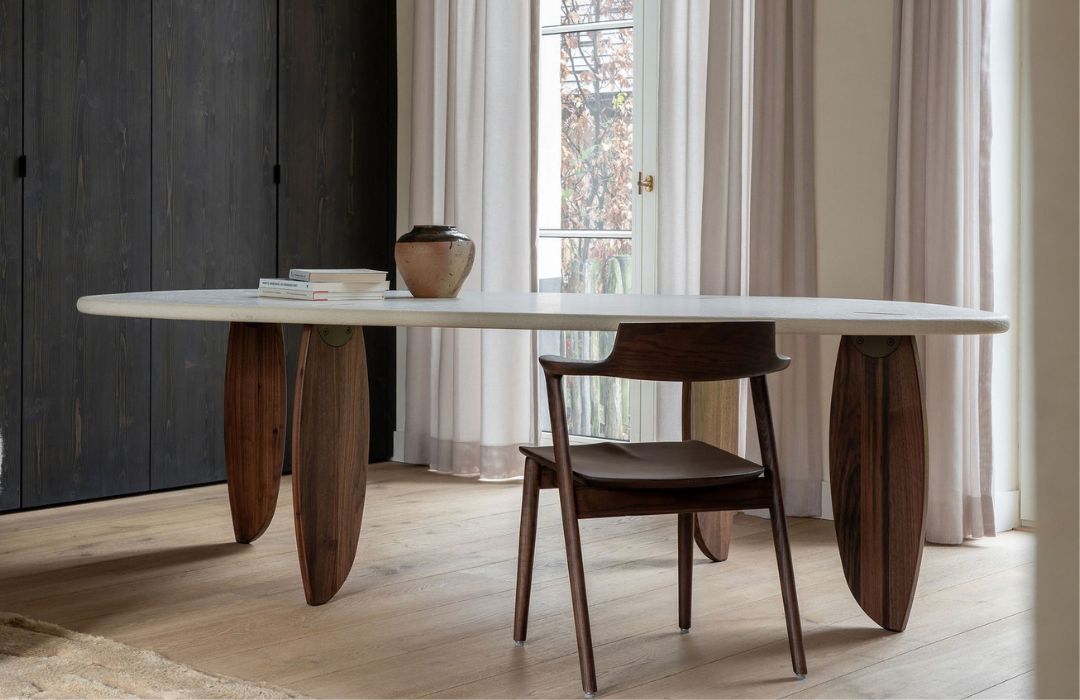
Sometimes, an interior has everything it needs, yet still feels like something is missing.
The right colours are there. The materials work together. The furniture is carefully selected. But the room lacks a focal point — something that brings everything together and gives the space its own identity.
In a dining room, that role can be played by the dining table.
A statement dining table goes beyond function. Through its shape, proportions, material and craftsmanship, it can anchor an entire room. But statement furniture does not necessarily mean bold, oversized or extravagant.
Often, the strongest designs are the ones that feel perfectly at home in a space while still having a character of their own.
So, how do you choose a designer dining table that makes an impact without overpowering your interior?
What is a statement dining table?
A statement dining table is a table with enough visual character to become one of the defining elements of an interior.
That character can come from many things: an unusual shape, a sculptural base, distinctive proportions, an unexpected material or exceptional craftsmanship.
It does not have to demand attention.
A restrained table with beautiful proportions and a tactile mineral finish can make just as much of a statement as a highly expressive design.
The key is presence.
A good statement table gives the eye somewhere to rest and helps connect the different elements of the room.
Start with the room, not the table
It is tempting to fall in love with a dining table first and think about dimensions afterwards.
We recommend doing the opposite.
Start by looking at the architecture of the room.
Consider:
- the dimensions of the dining area
- the position of doors and windows
- circulation around the table
- natural sightlines through the room
- the number of chairs you need
- nearby furniture
- architectural features you want to emphasise
A large table can look spectacular in a showroom and feel overwhelming in a smaller dining room. Equally, a table that is too small can disappear in a large open-plan space.
The right statement dining table should command attention without compromising the way you move through the room.
As a general principle, leave enough space around the table to pull chairs back comfortably and walk behind them. But don’t rely on measurements alone: proportions and visual weight matter too.
Proportion is more important than size
Two dining tables with exactly the same dimensions can feel completely different in the same room.
Why?
Because proportion influences how we perceive an object.
A thick tabletop combined with a substantial base creates a strong architectural presence. A thinner top with more open space underneath can make the same dimensions feel considerably lighter.
Look at the relationship between:
- tabletop length and width
- tabletop thickness
- height
- size of the base
- open versus solid areas
- distance between the base and the edge of the table
In a spacious interior, stronger proportions can help anchor the dining area. In a more compact setting, a visually lighter design can create presence without making the room feel crowded.
Choose a shape that works with the architecture
Shape has an enormous influence on both the atmosphere and functionality of a dining area.
Rectangular dining tables
A rectangular table creates structure and works naturally in long rooms. Its clean geometry can reinforce architectural lines and create a calm, balanced composition.
Round dining tables
Round tables soften an interior and encourage conversation because everyone is oriented towards the centre. They can work particularly well in square rooms or areas where circulation happens on several sides.
Oval and organic dining tables
An organic dining table sits somewhere between these two worlds.
Soft curves introduce movement without losing the functionality of an elongated table. Organic shapes can also create an interesting contrast in interiors dominated by straight architectural lines.
They are particularly effective when you want the table itself to feel more sculptural.
The best choice isn’t simply the shape you like most. Look at the lines already present in the architecture and decide whether the table should continue them or deliberately contrast with them.
Organic or geometric: what feeling do you want to create?
This is where choosing a dining table becomes more emotional.
Geometric forms tend to bring order, rhythm and architectural clarity.
Organic forms introduce softness, movement and a more natural feeling.
Neither is inherently better.
A highly minimalist interior can benefit from an organic table that breaks up its straight lines. A room containing many soft forms might instead need a more geometric table to create structure.
Ask yourself:
What does the room already have, and what is it missing?
That question is often more useful than asking which dining table is currently in style.
Pay attention to visual weight
Visual weight has little to do with how many kilograms a table actually weighs.
It describes how heavy an object looks within a room.
Dark colours, thick surfaces and closed bases generally create more visual weight. Lighter finishes, open structures and refined proportions tend to make furniture appear lighter.
This becomes particularly important in open-plan interiors.
A sculptural dining table can visually define the dining zone without walls or partitions. Its presence effectively says: this is where the dining area begins.
But balance matters. If the chairs, lighting, rug and table are all competing to be the focal point, the room can quickly feel restless.
Choose where you want the visual emphasis to be.
Don’t underestimate the table base
We naturally look at the tabletop first, but the base can completely transform the character of a table.
Traditional four-leg construction tends to feel familiar and functional.
A sculptural table base, on the other hand, turns the table into an object that can be appreciated from different angles.
It can introduce:
- repetition
- curves
- symmetry
- asymmetry
- negative space
- architectural volume
This is especially important in open interiors where the dining table can be seen from the kitchen, living area or entrance.
At Atelier Nilsen, the relationship between tabletop and base is therefore an integral part of the design. In several of our pieces, the lines of the base respond to or follow the shape of the tabletop rather than functioning as a separate element.
The result is a table that reads as one coherent object.
Choose a material you will still appreciate years from now
Material determines much more than appearance.
It influences texture, light, maintenance, ageing and how the table interacts with the rest of your interior.
Natural materials and handcrafted finishes have an advantage here: subtle variation is part of their character.
Solid oak brings warmth and visible grain. Walnut introduces deeper tones. A Mortex or mineral finish creates a seamless, tactile surface with subtle variations created during its manual application. Metal can add precision and contrast.
Rather than asking which material is fashionable, consider how it relates to the permanent elements in your home:
- flooring
- kitchen finishes
- natural stone
- cabinetry
- window frames
- architectural details
A dining table can either complement those materials or provide deliberate contrast.
Both approaches can work beautifully.
Think about colour as part of the entire room
A statement table doesn’t need a statement colour.
In fact, a restrained colour palette often allows an interesting shape or material texture to become more visible.
Consider whether you want the table to blend into the surrounding palette or stand apart from it.
A tonal interior can create sophistication through subtle differences in texture. A contrasting dining table, on the other hand, can immediately establish a focal point.
Also consider how the colour behaves throughout the day. Natural and mineral surfaces can look quite different in morning daylight, direct sunlight and warm artificial light.
Whenever possible, evaluate finishes in relation to the actual materials and lighting conditions of the room.
Your chairs don’t have to match the table
Dining chairs and tables should work together, but they don’t have to belong to the same visual family.
Contrast can make both elements stronger.
A substantial sculptural table can work beautifully with refined chairs. An understated table can support more expressive seating.
Pay particular attention to:
- seat height
- armrest height
- available legroom
- number of chairs
- width between table legs or bases
- materials and colours
And remember the practical side: a beautiful chair that cannot comfortably slide underneath your table will become frustrating remarkably quickly.
Treat lighting and the dining table as one composition
Lighting is often chosen after the table, but visually they form one composition.
A pendant light draws attention to the dining area and can reinforce the shape of the table underneath it.
For example, a linear pendant can emphasise the length of a rectangular table, while a sculptural fixture can create an interesting dialogue with an organic tabletop.
Scale is particularly important.
A light that is too small can look lost above a substantial designer table. One that is too dominant can compete with it.
If your dining table is the main statement piece, the lighting does not necessarily need to be another one.
Sometimes restraint is what makes the strongest element stand out.
Don’t design your interior around a trend
Organic shapes, particular stone varieties, certain woods and specific colours will move in and out of fashion.
A high-quality dining table should outlast those cycles.
Instead of asking:
“Will this look current?”
ask:
“Will I still appreciate this in ten years?”
Look for qualities that don’t depend on trends:
- balanced proportions
- considered details
- quality materials
- craftsmanship
- functionality
- a distinctive but coherent design language
Timeless does not have to mean conventional.
A highly original piece can remain relevant for decades when its design has a reason to exist beyond the trend that surrounded its creation.
Why handcrafted furniture feels different
With mass-produced furniture, consistency is usually the goal. Every piece should look exactly like the previous one.
Handcrafted furniture has a different quality.
The grain of a piece of solid wood varies. A mineral finish applied by hand develops subtle differences in texture and movement. Small nuances reveal something about how the object was made.
At Atelier Nilsen, our furniture is handcrafted in our Belgian atelier. Materials such as Mortex, solid oak and walnut are selected and finished with attention to the individual design.
Those differences aren’t something we try to hide. They are part of what gives a handcrafted dining table its character.
So, how do you choose the right statement dining table?
Don’t start by asking which table is the most striking.
Start with your space.
Look at its architecture, dimensions, existing materials and the way you live. Determine what is already working and, more importantly, what feels missing.
Then consider the table’s:
- Proportion – does it feel balanced within the room?
- Shape – does it complement or contrast with the architecture?
- Visual weight – does it anchor the room without overwhelming it?
- Base – does the design remain interesting from every angle?
- Material – will you enjoy living with it and caring for it?
- Colour – how does it interact with the rest of the palette?
- Chairs and lighting – do they create one balanced composition?
- Longevity – would you choose it even if today’s trends disappeared?
The best statement dining table isn’t necessarily the loudest piece in the room.
It’s the one that makes the room feel complete.
Discover handcrafted dining tables by Atelier Nilsen
At Atelier Nilsen, we approach a dining table as more than a functional surface.
Shape, base, proportion and material are considered as one composition, resulting in sculptural furniture with a distinctive but timeless presence.
Each piece is handcrafted in Belgium using carefully selected materials and finishes, including Mortex and other refined material combinations.
Explore the Atelier Nilsen dining table collection and discover a piece designed not simply to fill your dining room, but to become part of its architecture.